Of all the knee jerk green-media beatups – that of “worst drought ever” or variations on that theme to cover the years 2001 and later – would one of the most predictable storylines of recent years.
My experience is that when rainfall data for an area in question are examined – the claims usually do not stand up. But lets take a broadbrush approach –

The graphic of Australian wheat production history (2010 number is an estimate from Abare) indicates a few dry years in the last decade but there must have been much useful rain.
Agreed ? – or wheat does not grow.
I quite agree Warwick, there also looks as if there is a correlation between increasing wheat production and increasing atmospheric CO2 levels.
I suppose you would have to take into account better cropping techniques, herbicides, fertilizer, grain varieties etc – but sure rising CO2 would play a part.
Great to see Andrew Bolt exposing the hopeless 3 month “Outlook” models of the BoM – only MSM media that does so I think.
Wheat farmers really have it tough in Australia, from drought to booms, then bust many times over the years. Some of the worst droughts I have seen were in the ’70’s when I was a stock agent, the wetter good years were often accompanied by disadvantages in selling prices or adverse dollar values. As a farm machinery sales rep in the ’80’s, interest rates were the killer.
Warwick can you do a post on this story
www.theaustralian.com.au/news/breaking-news/murray-darling-basin-getting-drier-study/story-fn3dxity-1225942344935
(quoting selectively)
MORE evidence has emerged of a long-term trend towards a drier climate in the Murray-Darling Basin and much of southeastern Australia, despite welcome rains in 2010.
Research released by the South Eastern Australian Climate Initiative highlights the effects of climate change on the basin’s water resources, which support 40 per cent of the nation’s farmers.
The research confirmed the 13-year drought was unprecedented in its extent, in reduced year-to-year rainfall variability, and in the seasonal pattern of rainfall decline.
The drop was significantly more than during the World War II drought (23 per cent) andthe Federation drought (27 per cent).
Contributing factors included a decline in rainfall in autumn through to spring, a lack of high-rainfall years over the past decade and higher temperatures.
Program director David Post said these changes were linked to large-scale atmospheric circulation patterns. They indicated a shift in the overall climate of southeastern Australia, similar to what has been experienced in southwest Western Australia since the 1970s, Dr Post said.
“The research indicates that these changes can be linked to global warming, making it a likely contributor to the recent drought,” he said.
The next three years of research will look at the extent to which the changes can be attributed to climate change, improve projections of the impacts on water resources and improve seasonal forecasting of climate and streamflow.
The research was carried out by the CSIRO and the Bureau of Meteorology with financial support from the Murray-Darling Basin Authority, Victorian Department of Sustainability and Environment, Commonwealth Department of Climate Change and Energy Efficiency, and the Managing Climate Variability Program.
Warwick I sent you a comment about the CSIRO BOM paper reported as breaking news in the Australian yesterday – I think this is the report here dated May 2010; www.csiro.au/files/files/py5t.pdf
I was particulary interested in how the streamflow reduction in the MDB was calculated and have now found this in the report at page 5
There has been a 13 per cent reduction in rainfall in
the southern MDB (the Goulburn-Broken, Campaspe,
Loddon-Avoca and Wimmera basins) over the period
1997-2006 compared with long-term averages,
which has led to an extreme decline in modelled
annual streamflow of 44 per cent relative to the
long-term average (1895 to 2006). The streamflow
reduction during the current drought period is
significantly higher than the reduction during the
World War II drought (23 per cent) and Federation
drought (27 per cent).
On my reading the streamflow is done on computer modelling
and this on page 11
While the current drought has seen annual rainfall decline
by an average of 11.4 per cent across south-eastern
Australia, the impact on streamflow21has been even more
extreme. While some magnification of the response in
streamflow relative to rainfall is expected (Chiew, 2006),
the degree of this magnification in the recent drought is
unusual. For example, it is evident that average inflows
to the River Murray system over the period 1997-2009
are 50 per cent less than the long-term average, which is
a greater reduction than in either the Federation (1896-
1905) or World War II (1936-45) droughts (Figure 2). For
the southern Murray-Darling Basin (the Goulburn-Broken,
Campaspe, Loddon‑Avoca and Wimmera basins), the
ratio of the modelled streamflow reduction relative to
the rainfall reduction is 2.51 for the Federation drought,
1.54 for the World War II drought and 3.24 for the current
drought (Potter et al., 2010).
and at page 15
Figures 6a and 6b show updated results for changes
in rainfall and modelled streamflow over the period of
1997‑2008 relative to the 1895-2008 long-term mean
across south‑eastern Australia.
If you had time to do a post it would be much appreciated
Warwick; Here’s Dr Marohasy’s take:
(produced in less than 5 hours from the time I asked her:)
On Thursday the New South Wales Government officially declared the nine-year drought ended. The very next day the CSIRO released a report warning that the ‘current drought’ appears to be at least partly linked to ‘climate change’.
The CSIRO report entitled ‘Climate variability and change in south-eastern Australia’ is an initiative of the South Eastern Australian Climate Initiative, SEACI, lead by CSIRO with input from the Bureau of Meteorology and the Murray-Darling Basin Authority.
The report forecasts a future decline in rainfall and works from the assumption there is already long term decline.
The first diagram, Figure 1, however, only shows historical rainfall data for the period 1997 to 2009 excluding the last very wet ten months. The first graph, Figure 2, shows inflows, not rainfall, across the Murray Darling Basin without explaining that many variables impact inflows that have nothing to do with rainfall including changes in land management, salt interception and drainage schemes etcetera.
A scientific report of this kind might have begun with a discussion of the complete historical rainfall record and avoided confusing inflows with actual rainfall.
The report’s forecast of a drier future could come to pass, but the track record of Australian climate scientists for predicting rainfall even one season ahead is dismal. The Bureau incorrectly forecast below average rainfall for spring this year for the upper Murray catchments just before the region was flooded. Last year the forecast for a hot and dry summer resulted in drought breaking rains across the upper Murray Darling Basin.
Rainfall – the most significant climate variable – is spectacularly changeable and non-robust from one climate model to the next.
Professor Gareth Paltridge in his book ‘The Climate Caper’ (Connor Court, 2009, pg 21) makes reference to an Australian National University study of the various simulations of rainfall as produced by the IPCC models. The simulations of average Australian rainfall apparently range from less than 200mm per year to greater than 1000mm per year. The actual measured value is 450mm. Considering the forecasts for the late 21st Century, apparently more than half the models predict an increase in rainfall over Australia, and the rest predict a decrease. The most extreme decrease is from the CSIRO IPCC model which suggests that average rainfall over Australia 100 years from now will be 100mm per year less.
At the global scale, according to AGW theory, an increase in carbon dioxide should lead to an increase in water vapour concentrations and therefore more cloud. But there is some empirical evidence to suggest that water vapour feedback is in fact negative, not positive.
In summary, there is no reason to suggest that the new SEACI forecast for a decline in rainfall across south eastern Australia will be any more accurate that previous CSIRO and Bureau of Meteorology seasonal and long range forecasts that have proven unreliable. Furthermore it is of concern that the report purportedly about south eastern Australia, released in October 2010, makes continual reference to the ‘ongoing drought’ and ‘current drought’ when south eastern Australia is no longer in drought.
Dr Marohasy says ‘Be careful not to confuse rainfall with runoff.’ and “runoff is calculated by climate modelling’
check Dr Marohasy’s site for her credentials jennifermarohasy.com/blog/2010/10/new-csiro-climate-forecast-for-se-australia-unbelievable/
Val, I have just found two of your comments (very similar) caught in the anti-spam list. The longer one is released now as comment 4. So thanks for that article from the Australian – I was going to ask you for it. (And I know Dr J.M. and am glad she is back again in public debates.)
Today the Canberra Times is headlined “Big dry will be back: CSIRO” – unfortunately not online – but it reads very similar to the piece in The Australian.
They are quoting the CSIRO’s Dr David Post and his latest views expressed in many other places online. However only in January 2010 Dr Post was promulgating a diametrically opposed view – saying that the MDB drought could not be attributed to climate change.
The CT article quotes the CSIRO report “South Eastern Australian Climate Initiative” and says Dr Post is a principal author – yet Dr Post is not listed as an author of the May 2010 CSIRO pdf report “South Eastern Australian Climate Initiative” that you linked to.
So maybe there is another report titled “South Eastern Australian Climate Initiative” ?
Anyway – the May 2010 “South Eastern Australian Climate Initiative” is a mish mash of the usual doomster predictions by the assorted collection of taxpayer funded Greenhousers – who in this case have all fallen spectacularly on their faces as there has been notable useful rains from the time the report was issued and the MDB runs from top to Murray-mouth. Any half-critical media would laugh at them – trotting out this failed report.
We can be sure that whenever the “expensive water lobby” – Wentworth Group – CSIRO – BoM – and assorted other members of the broad climate change cabal – want to get their views in the MSM – then the ever faithful GreenMSM obediently makes space and any critical faculties are suspended.
Here are some ideas on the issue of runoff/inflows and the unreliability of constructing long term time series of river data modeling so beloved by the “expensive water lobby”.
These are some essential points I have made re the ACT that mostly apply to the MDB too.
[1] Trends derived from the time series of historic inflow numbers so beloved by ACTEW and the doomsters and proponents of expensive water, the Wentworth Group etc – are nowhere near as credible as trends from long term rainfall data.
[2] Stream gaging was not common a century ago. Stream gaging was much more widespread post the 1940’s than pre 1940’s and equipment costs mean the networks are more sparse than rain data networks.
[3] Stream gaging has been carried out by a multiplicity of methods and techniques and can involve quite expensive equipment to be installed in remote areas – whereas measuring rainfall has always been relatively simple and cheap.
[4] The Queanbeyan rain history shows with crystal clarity that the last decade has NOT been exceptionally dry compared to the 1930’s-40’s and 1890’s thru to WWI.
[5] It also must be noted that there are NO reliable long term rain data from high up the vital Cotter catchment – so we are stuck with using Queanbeyan as a guide to ACT historic rain trends.
[6] So when the ACT Govt promulgates their inflows history which show the last decade to be exceptionally dry – in conflict with the Queanbeyan rain data – I say “..the ACT inflow data – not worth the paper it is printed on in terms of being an accurate comparison of recent inflows with late 19C and early 20C inflows..”
[7] When you also feed in the facts that the ACT Govt are promulgating this dubious inflow history and they are advocates of CSIRO climate modeling – my conclusion in 6 is reinforced.
If anybody can show me a 139 year long stream gage record from an ACT/MDB high country stream – using the same equipment throughout – no gaps and missed data – that would indeed be an interesting discovery.
Other facts worth stating that illustrate the complexities behind trying to make long term time series of inflows;
Changes in vegetation cover have a marked impact on inflow rates or catchment efficiency – more vegetation = less runoff / inflows.
So periods in our history when land clearing was dominant – say after settlement and post WWI and WWI soldiers block schemes- would have tended to increase runoff.
Other opposing factors such as post WWII soil conservation programs – reversion of marginal land to scrub – the huge increase in timber plantations in post WWII decades – the “plant a billion trees” campaign launched by PM Bob Hawke over 20 years ago – would have all acted to reduce runoff and inflows.
There is another neglected factor affecting our SE Australian rainfall and that is the post WWII airborne cloud seeding that ran intermittently for several decades – I think to the early 1990’s in some areas. This time series of NSW rain from 1900-2009 shows the huge jump in rain in 1950 –
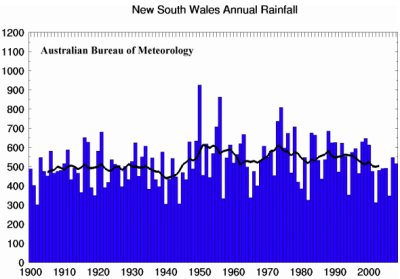
which happened to be when cloud seeding started. The implications of this are that rain data for a wide area must be skewed upwards to some extent by cloud seeding which makes the BoM – CSIRO analyses even more worthless than they already are. Enough for now.
Warwick thanks for your reply which I have linked to
www.climateconversation.wordshine.co.nz/open-threads/climate/scene/australia/
I’m intending to contact Quadrant Online and I’ll refer it to your comment and Dr Marohasy’s comment and to your new post which I’ll now go and read
Warwick, I checked the CSIRO site and can’t come up with the missing report
so that’s a mystery
but I will keep looking
‘the curious case of the missing report’ to quote another esteemed author
and did the dog bark in the night?
Warwick I’ve left this comment on www.climateconversation.wordshine.co.nz/2010/11/the-bom-discovers-uhi/
Climate conversation group
Here goes; I have no scientific training or expertise so hope I get this accurate but if I don’t I’m sure someone will correct me
The BOM temperature data consists of (using BOM’S words)
1. The Australian Reference Climate Station (RCS) network established for high quality, long-term climate monitoring, particularly with regard to climate change analysis.
2. High Quality HQ dataset containing the Operational monitoring of Australia’s changing climate
3. Historical climate data (raw data) provided in both graphical and textual formats at climate sites. Graphs can be viewed as either mean/total data or as anomalies from the standard 1961-1990 base period (1971-2000 is used for pan evaporation due to shortness of record). Daily data are only plotted from 1995 onwards to avoid over-crowding the graphs, but the full daily record is available as text.
The HQ dataset is the set on which the official Australian temperature analyses are based. The network is shown at www.bom.gov.au/climate/change/hqsites/. You can google BOM High Quality to go to the BOM page. For temperature enthusiasts an explanation of the methodology is here ftp.bom.gov.au/anon/home/ncc/www/change/HQannualT/HQannualT_info.pdf Homogenity is the key. A non-urban set of 99 stations from the updated HQ dataset are used to prepare timeseries of annual all-Australian temperature, and maps of trends in temperature. Based on the methodology used for annual trends urban sites (sites that have or have had at some time since 1910 a population over 10,000) are not to be included.
Ken Stewart’s work compares the HQ to the raw data. The HQ dataset is well explained on Ken’s site under the heading The Australian High Quality Climate Site Dataset kenskingdom.wordpress.com/2010/05/12/the-australian-temperature-record-part-1-queensland/ together with explanations Ken received from BOM to enquiries. Ken found just in Qld some urban sites are included. Other states have similar anomalies.
My understanding is the BMO make no allowance for UHI in its HQ dataset when preparing timeseries as the 99 stations are ‘non urban’. However, notwithstanding the HQ dataset rules (that is that is that sites should not be included if they are urban sites if they have had a population over 10,000 at some time in the last 100 years) this rule has not been uniformly applied so there are many sites in the BOM HQ timeseries data which have no adjustments for UHI.
Ken’s conclusion in his Problems in his Big Picture article with the HQ data include:
• It has been subjectively and manually adjusted.
• The methodology used is not uniformly followed, or else is not as described.
• Urban sites, sites with poor comparative data, and sites with short records have been included.
• Large quantities of data are not available, and have been filled in with estimates.
• The adjustments are not equally positive and negative, and have produced a major impact on the Australian temperature record.
• The adjustments produce a trend in mean temperatures that is roughly a quarter of a degree Celsius greater than the raw data does.
• The warming bias in the temperature trend is over 40%, and in the anomaly trend is 50%.
• The trend published by BOM is 66.67% greater than that of the raw data.
The questions remain
1. The extent if any to which temperatures were subjectively altered even before they gained the description “raw data”.
2. What if any adjustment is BOM prepared to make to its HQ dataset for those of its 99 ‘non urban’ stations which are undoubtedly ‘urban’
UHI is a huge problem.
Warwick Hughes has some articles on his site about UHI www.warwickhughes.com/blog/index.php?s=uhi including Two degrees C Urban Heat Island in small village of Barmedman, NSW, Australia (277 people)
If you have time could you visit and add a comment;